Concurrency Part 1
Parallelism through Threads
Revisiting our Game from chapter 3
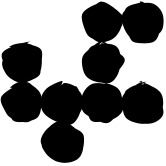
How to create multiple independent actors? How do they get access to the board?
Terminology

Parallelism
- The stronger form of concurrency
- Multiple things happening at the same time
- Concurrency only implies multiple things happening within the same time span
- Many ways of achieving parallelism:
- Instruction-level parallelism (pipelining, superscalar execution)
- Vectorization
- Threads
- Processes
Parallel streams of instructions
- Machine code is executed sequentially (from the programmer’s point-of-view)
- If we have multiple cores, we can run multiple streams of instructions in parallel
- The OS encapsulates these streams in the form of threads and schedules threads onto the available CPU cores
- A form of concurrency (e.g time-slicing)
Threads vs. processes
| Feature | Threads | Processes |
|---|---|---|
| Address space | Shared | Separate |
| Stacks | Separate | One per thread |
| Program Counter | Separate | One per thread |
| Creation cost | Cheap(-ish) | Expensive |
Thread control
- Threads are managed by the OS
- On bare metal: Set entry address for CPU cores manually
| Operation | POSIX | Windows |
|---|---|---|
| Creation | pthread_create |
CreateThread |
| Wait for completion | pthread_join |
WaitForSingleObject |
| Exiting | pthread_exit |
ExitThread |
| Suspend & Resume | Condition variables using pthread_cond_wait, pthread_cond_signal |
SuspendThread, ResumeThread, or condition variables |
Threads in systems programming languages
- Standard libraries typically abstract thread management into a platform-independent API
std::threadin C++threading.Threadin Pythonstd::threadmodule in Rust
- Plus various types and modules for synchronization
- Atomics, mutexes, semaphores, condition variables, channels, futures etc.
Threads and shared resources
- Threads share an address space, so they can share resources
- What does this tell us about ownership?
fn main() {
    let mut board = gen_board();

    let split_point = 4;
    let counting_region = &board[..split_point];
    let scrambling_region = &mut board[split_point..];

    // Both threads share the `board` resource, but who owns it?
    // (WARNING: Doesn't compile!)
    std::thread::spawn(|| count_whites(counting_region));
    std::thread::spawn(|| scramble(scrambling_region));
}
Ownership models

Ownership models (cont.)

Ownership models (cont.)

Ownership models (cont.)
- Thread ownership is an extension of function ownership

The Rule Of One
- With threads, the Rule Of One suddenly makes more sense
- Concurrent reads and writes are memory unsafe (race condition)
- Concurrent readers (i.e. immutable borrows) are safe
- Writers must be unique (i.e. mutable borrows)
- The known Rust rules apply and prevent concurrency bugs!
Resource decomposition
- Writing concurrent algorithms often requires identifying independent (sub-)resources
- In our Go-Game: Scramble one section of the board, count another (disjoint) section
- This fixes concurrent access to our board, but doesn’t fix the lifetime requirement
- Each spawned thread may live longer than
main!
- Each spawned thread may live longer than
Threads and lifetimes
- A spawned thread can detach and run as long as the whole program
- Thread functions must live for
'static(i.e. as long as the program)
- Thread functions must live for
- Options:
- Use ownership transfer (move data into thread,
move || { ... }) - Use scoped threads (
std::thread::scope) - Use shared ownership (
Arc<T>) - (Global variables (
static))
- Use ownership transfer (move data into thread,
Ownership transfer
- Use when one thread creates a piece of work and another thread processes it
Scoped threads
- Use when you want to process data owned by the current function from multiple threads
Shared ownership
- Use when multiple threads need access to the same resource but no single thread is the “main” thread
fn process(lut: &[u8]) { todo!() }

fn main() {
    let lookup_table: Vec<u8> = build_lut(configuration);
    // Lift to multiple ownership (tracked at runtime):
    let multi_owner_lut = Arc::new(lookup_table);
    const NUM_WORKERS: usize = 4;
    for _ in 0..NUM_WORKERS {
        // Clones the *handle*, not the LUT itself!
        let lut = Arc::clone(&multi_owner_lut);
        std::thread::spawn(move || process(lut.as_ref()));
    }
}
When to use which?
- When would you use shared ownership, scoped threads, or ownership transfers?
- Configuration object accessible from multiple threads, loaded at program startup
- Fork-join parallelism, e.g. processing a file in parallel
- Batch-writing of e.g. log messages to disk
- Concurrent compaction step of an append-only database (like in the lab)
- Rendering thread that processes draw commands generated from another thread in a game engine
- Producer/consumer problems, e.g. chunk-wise image decoding
- Response handler in an HTTP server, using an in-memory cache
Shared ownership problems
- Shared ownership requires heap allocations and runtime tracking of owners
- Typically realized through reference counting (
Arc<T>: Atomic Reference Counted)
- Typically realized through reference counting (
- Shared ownership breaks the Rule Of One!
- Multiple owners means one owner might write while the other reads
Arc<T> in practice
- Use-case: A lookup-table (LUT) shared between threads and generated lazily
Arc<T> in practice (cont.)
fn process(lut: &Lut, thread_id: u8) {
    println!("{}", lut.lookup(thread_id));
}

fn main() {
    // Lazily calculated LUT
    let shared_lut = Arc::new(Lut::default());
    const NUM_WORKERS: usize = 4;
    for id in 0..NUM_WORKERS {
        let lut = Arc::clone(&shared_lut);
        std::thread::spawn(move || process(lut.as_ref(), id as u8));
    }
}
Arc<T> in practice (cont.)
fn process(lut: &Lut, thread_id: u8) {
    println!("{}", lut.lookup(thread_id));
}

fn main() {
    // Lazily calculated LUT
    let shared_lut = Arc::new(Lut::default());
    const NUM_WORKERS: usize = 4;
    for id in 0..NUM_WORKERS {
        let lut = Arc::clone(&shared_lut);
        std::thread::spawn(move || process(lut.as_ref(), id as u8));
    }
}
cannot borrow `*lut` as mutable, as it is behind a `&` referenceArc<T> in practice (cont.)
- Let’s just replace
as_refwithas_mut:
fn process(lut: &mut Lut, thread_id: u8) {
    println!("{}", lut.lookup(thread_id));
}

fn main() {
    // Lazily calculated LUT
    let shared_lut = Arc::new(Lut::default());
    const NUM_WORKERS: usize = 4;
    for id in 0..NUM_WORKERS {
        let lut = Arc::clone(&shared_lut);
        std::thread::spawn(move || process(lut.as_mut(), id as u8));
    }
}
no method named `as_mut` found for struct `Arc<Lut>` in the current scopeThe API of Arc<T>
- There is
Arc::get_mut, but it looks like this:
- It will return
Noneifthishas more than one owner (i.e. the reference count is> 1) - The documentation states:
Shared references in Rust disallow mutation by default, and Arc is no exception: you cannot generally obtain a mutable reference to something inside an Arc.Reference counting and interior mutability
- Reference counted pointers (
Arc<T>,Rc<T>) only allow&Taccess - We need a way to obtain a
&mut Tfrom a&Arc<T>(or&Rc<T>) - Clearly, this is only sometimes safe: If we currently are the only ones trying to get mutable access
- Just like
Arc<T>tracks the number of owners at runtime, we can track the number of borrows at runtime - This is called interior mutability
- Just like
- Examples:
Cell<T>,RefCell<T>for single-threaded codeMutex<T>,RwLock<T>,Atomic<T>for multi-threaded code
Terminology
- Inherited mutability: If I have a
&Thing, all member variables ofThingare also immutable for me- The mutability is inherited from the outer type to the members
- Interior mutability: If I have a
&Thing, I can still mutate the member variables ofThing- The mutability is an interior property and not related to the outer type
Interior mutability example using Cell<T>
- The Rule Of One only applies if we borrow data. What if we always copy it instead?
use std::cell::Cell;

struct SomeStruct {
    regular_field: u8,
    special_field: Cell<u8>,
}

let my_struct = SomeStruct {
    regular_field: 0,
    special_field: Cell::new(1),
};

let new_value = 100;

// ERROR: `my_struct` is immutable
// my_struct.regular_field = new_value;

// WORKS: although `my_struct` is immutable, `special_field` is a `Cell`,
// which can always be mutated
my_struct.special_field.set(new_value);
assert_eq!(my_struct.special_field.get(), new_value); // get() returns *copy*
“But I want access to the same value!”
- Then we need to count the number of borrows and fail if there is already a mutable borrow
use std::cell::RefCell;

struct SomeStruct {
    regular_field: u8,
    special_field: RefCell<u8>,
}

let my_struct = SomeStruct {
    regular_field: 0,
    special_field: RefCell::new(1),
};

let mut borrow = my_struct.special_field.borrow_mut();
*borrow = 100;
// Calling .borrow() again would panic!
// my_struct.special_field.borrow()“RefCell<T> looks like magic!”
RefCell<T> in multi-threaded code
fn process(lut: Arc<RefCell<Lut>>, thread_id: u8) {
    let mut borrow = lut.borrow_mut();
    println!("{}", borrow.lookup(thread_id));
}

fn main() {
    // Lazily calculated LUT
    let shared_lut = Arc::new(RefCell::new(Lut::default()));
    const NUM_WORKERS: usize = 4;
    for id in 0..NUM_WORKERS {
        let lut = Arc::clone(&shared_lut);
        std::thread::spawn(move || process(lut, id as u8));
    }
}
RefCell<T> in multi-threaded code
fn process(lut: Arc<RefCell<Lut>>, thread_id: u8) {
    let mut borrow = lut.borrow_mut();
    println!("{}", borrow.lookup(thread_id));
}

fn main() {
    // Lazily calculated LUT
    let shared_lut = Arc::new(RefCell::new(Lut::default()));
    const NUM_WORKERS: usize = 4;
    for id in 0..NUM_WORKERS {
        let lut = Arc::clone(&shared_lut);
        std::thread::spawn(move || process(lut, id as u8));
    }
}
`RefCell<Lut>` cannot be shared between threads safely
the trait `Sync` is not implemented for `RefCell<Lut>`
if you want to do aliasing and mutation between multiple threads, use `std::sync::RwLock` insteadThread-safety at the type level
RwLock<T>(orMutex<T>) will solve our problemArc<RwLock<T>>orArc<Mutex<T>>is a common Rust pattern for shared mutable ownershipArc<T>shares an instance between threadsMutex<T>/RwLock<T>prevent race conditions
- Rust detects thread-safety at the type level through two traits:
SendandSync
Send and Sync
- A type implements
Sendif it is safe to send it to another thread - A type implements
Syncif it is safe to share between threads - These two marker traits form a relation:
TisSyncif and only if&TisSend- “Sending a shared reference to another thread is the same as sharing the value between threads”
- Things that are not
Send/Sync- Raw pointers (anything goes)
UnsafeCell<T>(explicitly allows shared mutable state)Rc<T>(uses raw pointers internally)
Send and Sync as generic bounds
- Here is
std::thread::spawnagain:
Arc<T>is onlySendifTisSync- By definition: Multiple
Arcs point to the same value, sending oneArcto another thread gives that thread access to the underlying value, so the value must beSync!
- By definition: Multiple
The fixed Game code
fn process(lut: Arc<Mutex<Lut>>, thread_id: u8) {
    let mut lut = lut.lock().expect("Lock was poisoned");
    println!("{}", lut.lookup(thread_id));
}

fn main() {
    // Lazily calculated LUT
    let shared_lut = Arc::new(Mutex::new(Lut::default()));
    const NUM_WORKERS: usize = 4;
    for id in 0..NUM_WORKERS {
        let lut = Arc::clone(&shared_lut);
        std::thread::spawn(move || process(lut, id as u8));
    }
}
These are all the rules we need to know for writing thread-safe code in Rust!